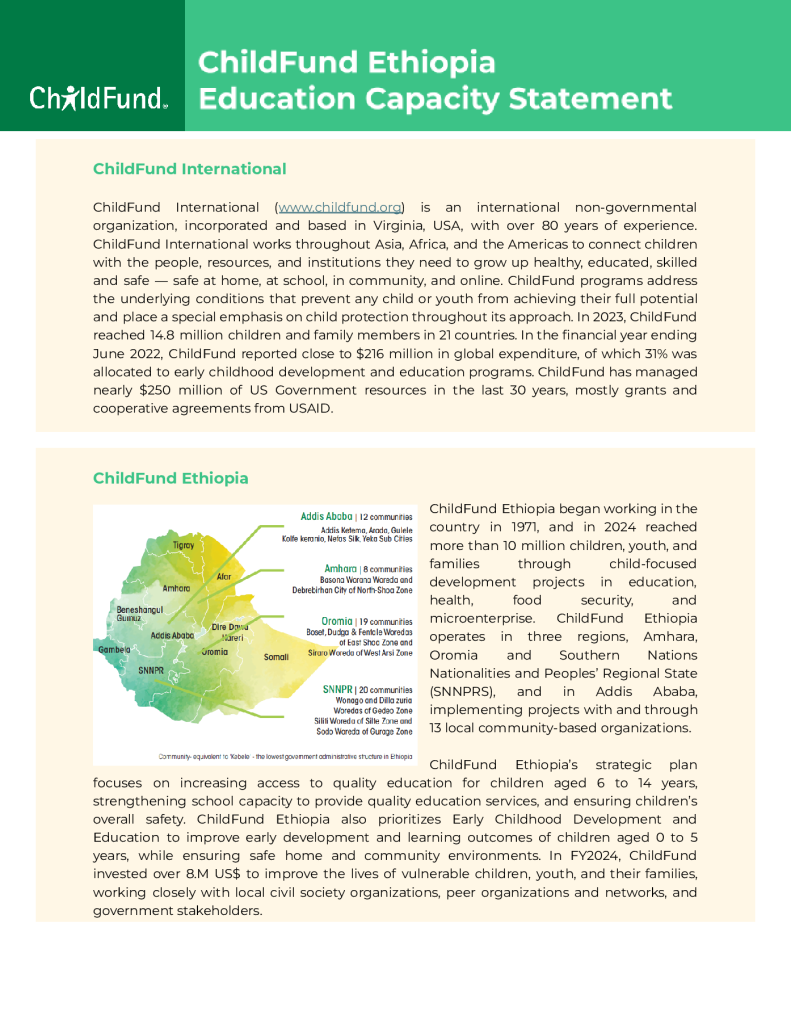
In any crisis, children's needs must come first.

Ethiopia, like many parts of the world, is navigating a complex mix of conflict, environmental shocks, and economic pressures. These challenges—compounded by global instability—have created a difficult environment for children, who are always the most vulnerable in times of crisis.
The compounded effects of these challenges, often resulting in widespread displacement, generate high levels of humanitarian need across the country. More than 21 million people in Ethiopia will require humanitarian assistance in 2024 (UN).
In regions where ChildFund works, the impact is deeply felt. Since 2021, Amhara has faced a severe humanitarian crisis driven by conflict, disease outbreaks, drought and flooding. In Tigray, the conflict that erupted in 2020 sparked a massive humanitarian crisis that outpaced the aid community’s ability to respond. Today, an estimated 4.5 million people are still in need of assistance.
ChildFund stands with affected children and families. We support both displaced and host populations with life-saving humanitarian aid and long-term recovery programs focused on child protection, education, health, and psychosocial support.
In 2024, ChildFund reached over 3 million people in Amhara and Tigray regions, including over 1,000,000 children—helping them to heal, learn, and thrive in the face of adversity.

Last year, ChildFund helped more than 3 million people affected by emergencies in Ethiopia.

Our Impact

Facts and  figures from 2024 data.

How we Support Children & Families after Emergencies

We Provide Relief

To Children, Families  and Communities affected  by emergencies in the form of food,  clean water and  other essentials, like blankets and hygiene kits. Depending on the situation, we may distribute these items directly to affected families or give them funds  to purchase what  they need most.

We Establish Child-Centered Spaces

To give Children a safe place  to play, learn and just  be kids – activities that are crucial to their recovery from the trauma of emergencies.  These spaces protect the children and allow their parents time to find shelter, food, water and other help they need.

We Promote Education

On disaster preparedness so that  when emergencies happen, children, families and communities  know how to respond and can recover more quickly.

Our Approach: Protection for the Most Vulnerable

ChildFund places children's safety and well-being at the center of humanitarian response. We work hand-in-hand with local communities, partners, and government authorities to raise awareness of child protection risks and create safe environments for children. Our efforts include providing essential services such as case management, family tracing, and reunification, offering psychosocial support to help children cope with trauma, and strengthening community-based child protection mechanisms.
Because children’s needs are often sidelined in humanitarian responses, ChildFund builds Safe Spaces where children, youth and the most vulnerable populations can access lifesaving services and children can learn and play in safety, with access to psychological first aid, while their adults seek the resources they need. We also provide mental health support for caregivers and distribute emergency supplies like dignity kits.

Joining Forces on Child Protection in Emergency Project (CPiE):  Working with the Ministry of Women, Women, Children and Social Affairs, and our local partner Tesfa Berhan Child and Family Development Association, this project supported internally displaced persons (IDPs), host communities, and children in the North and South Wello zones of Amhara Region. It raised awareness of child protection risks, provided life skills training for children and youth, offered economic support to families, and strengthened community child protection groups. Additionally, the project provided specialized services, including case management and family tracing for children affected by violence or separation. In total, over 146,366 people participated, including 95,000 children.
Learn more:
Child Protection in Emergencies Project in Amhara Region
Children and youth lead the fight against child trafficking in Ethiopia

Education is a basic right, yet children in crisis situations are often deprived of it. Education provides children with a sense of normalcy, restores hope, and helps reduce the long-term psychological impacts of violence, trauma, and instability.
At ChildFund, we work with communities, local partners, and government authorities at all levels to ensure that children affected by crises can continue learning. Whether through restoring access to formal schooling or providing non-formal education programs in humanitarian settings, our goal is to support children’s return to learning and lay the foundation for long-term recovery.

Play Matters Project in Amhara Region: This International Rescue Committee-funded project rehabilitated 10 schools (5 in Mersa and 5 in Woldia) in the Amhara Region, which were affected by conflict. The interventions included repairing damaged classrooms, providing furniture and scholastic materials, school uniforms, dignity kits, school feeding programs, WASH facilities, and teacher and student training on pedagogy and learning through play techniques. As a result, school attendance increased to 100%, up from 85%, reaching 10,136 students and ensuring continued learning even after the conflict. Learn More: Supporting Schools Affected by Conflict in Amhara Region. 

Tigray Education in Emergency Project: 
The Tigray Education in Emergency Project, funded by ChildFund International, Children Believe Fund, and ChildFund Germany, reached 8,500 people, including 3,400 children, in Kilteawlaelo Woreda. Through this initiative, we provided education, water, sanitation, hygiene, child protection, and non-food items. This included school rehabilitation, furnishing learning spaces, supplying scholastic materials, and offering psychosocial support.
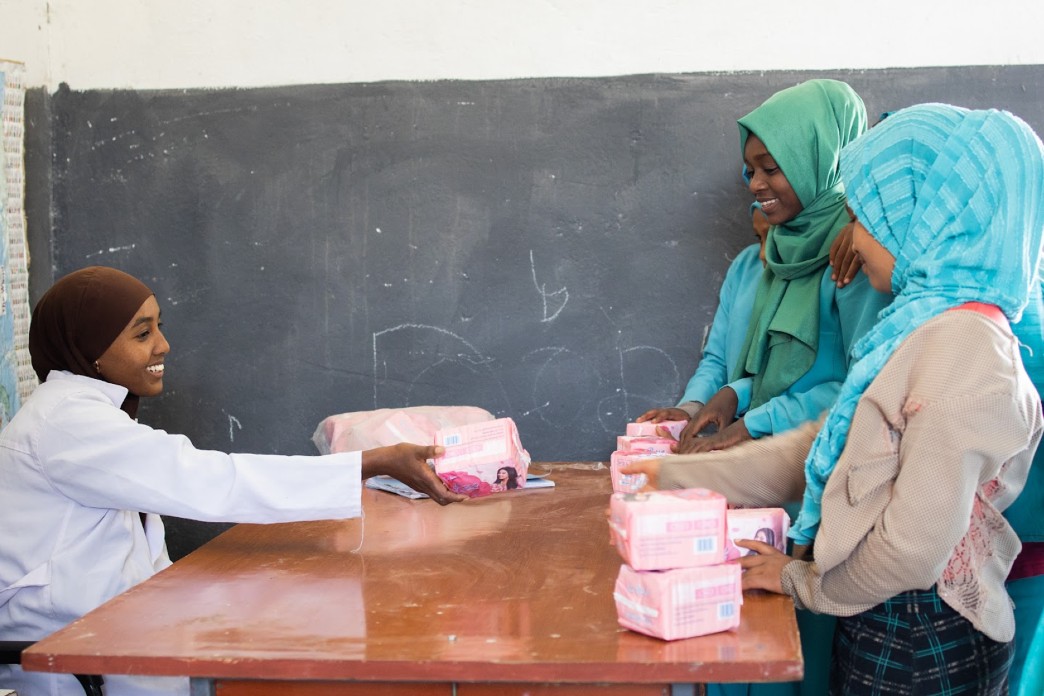
In communities where ChildFund has a presence, we support local systems including our local implementing partners, governments and communities to build resilience against crises. When a crisis erupts, ChildFund aims to safeguard children and their communities during the initial stages by mitigating risks of abuse, violence and other forms of harm.
Key packages include:

  • Provision of non-food items and dignity kits
  • Child-friendly spaces
  • Provision of mental health and psychosocial services
  • Safe identification and referral
  • Multipurpose cash for protection

This strategy strengthens our response within existing operational areas in Oromia, Amhara, Addis Ababa, Central and South Ethiopia, while allowing us to selectively expand our response to large-scale crises beyond these areas through partnerships.

Through robust collaboration and advocacy, we bridge humanitarian response and sustainable development. Leveraging ChildFund's extensive experience and partnerships, we influence local and national policies to prioritize the needs of the most vulnerable. Our approach ensures that the rights and well-being of displaced children and families are central to both immediate response and long-term recovery efforts.

Across programs addressing children in crisis, a critical shared element is their unique localization strategy, implemented effectively in complex humanitarian contexts. This approach involves working closely with relevant authorities and stakeholders from the community level to the national and international levels. The programs facilitate communication and cooperation among local partners and key actors, building relationships that extend beyond the programs' duration. All initiatives embody a holistic view, focused not only on the young people — the core population of interest — but also on their families, their teachers, their communities and other stakeholders who can help build supportive structures and promote access to education and livelihoods.

Featured Project

Supporting schools in conflict-affected communities in the Amhara Region

Following conflict in Ethiopia’s Amhara Region, the Play Matters Project restored access to education for thousands of children. Funded by the International Rescue Committee, the project rehabilitated 10 schools (5 in Mersa and 5 in Woldia) that had been damaged by conflict. The comprehensive response included classroom repairs, provision of furniture and learning materials, school uniforms, dignity kits, school feeding programs, and water, sanitation, and hygiene facilities.
The project also trained teachers and students in pedagogy and learning-through-play techniques to enhance the quality of education. As a result, school attendance rose from 85% to 100%, reaching 10,136 children and helping ensure that learning continued even in the aftermath of the crisis.

What's New?

  • All Posts
  • Child Protection
  • Child Sponsorship
  • Early Childhood Development
  • Education
  • Emergency Response
  • Environmental Sustainability
  • Expert Views
  • Food Security
  • Health & Nutrition
  • Localization
  • News & Stories
  • Press Releases
  • Water, Sanitation & Hygiene
  • Youth Development