

Creating a care economy that supports women and helps children thrive
March 6, 2025

Seble and her 3-year-old son, Hailu, outside the childcare center in Adama.
Meet Seble Aschale, a 35-year-old mother of two. Seble lives in Adama, a town south of Ethiopia’s capital, Addis Ababa. She has a 15-year-old daughter, Alem, from her first marriage and a 3-year-old son, Hailu, from her second. Providing for her family has always been a struggle. Her husband, who works at a local administration office, earns only $54 per month—far from enough to cover their monthly expenses, which include food, school supplies, and rent
To make ends meet, Seble took on multiple jobs. She washed clothes for people in the neighborhood and baked injera—Ethiopia’s staple food, a sour fermented pancake-like flatbread made of teff flour—to sell locally. She did all this while carrying baby Hailu on her back. “On a good day, I would make a total of $2,” she recalled. “But what is $2 in this economy? Even after working so hard, I still could not manage to feed my family. I would be forced to go and bring food from my parents’ house, which was quite embarrassing.”
The lack of childcare services affects women’s employment and economic opportunities. To address this challenge, ChildFund, in collaboration with various partners, is working to reduce the burden of care on women and improve their economic well-being through the establishment of community-based childcare centers that provide affordable, high-quality childcare services.
One such initiative is the Growth and Economic Opportunities for Women (GrOW) project, implemented by ChildFund Ethiopia in collaboration with Children Believe, Addis Ababa University, and Tesfa Berhan Child and Family Development Organization, with financial and technical support from the International Development Research Centre (IDRC).

“Since life had become unbearably expensive, I could not manage to support my firstborn child, Alem. She wanted to live with me, but I was not able to provide for her. So, her father took her to his home,” Seble said.
The project focuses on subsidizing and enhancing the quality of community based childcare services. By ensuring that mothers have access to reliable childcare,the initiative not only promotes women’s economic empowerment but also fosters Early Childhood Development (ECD). The project has demonstrated that quality childcare centers contribute significantly to the holistic development of children while simultaneously improving the financial stability of women.
To bridge this gap, ChildFund and Children Believe established and equipped 16 ECD centers in Adama, and Debrebirhan, that serve over 380 children aged 1 to 3. Each center serves 20 children and is managed by a center manager selected from the community. To ensure sustainability, mothers take turns supporting the center manager on a rotational basis, allowing them to leave their children in a safe environment while they focus on their businesses.
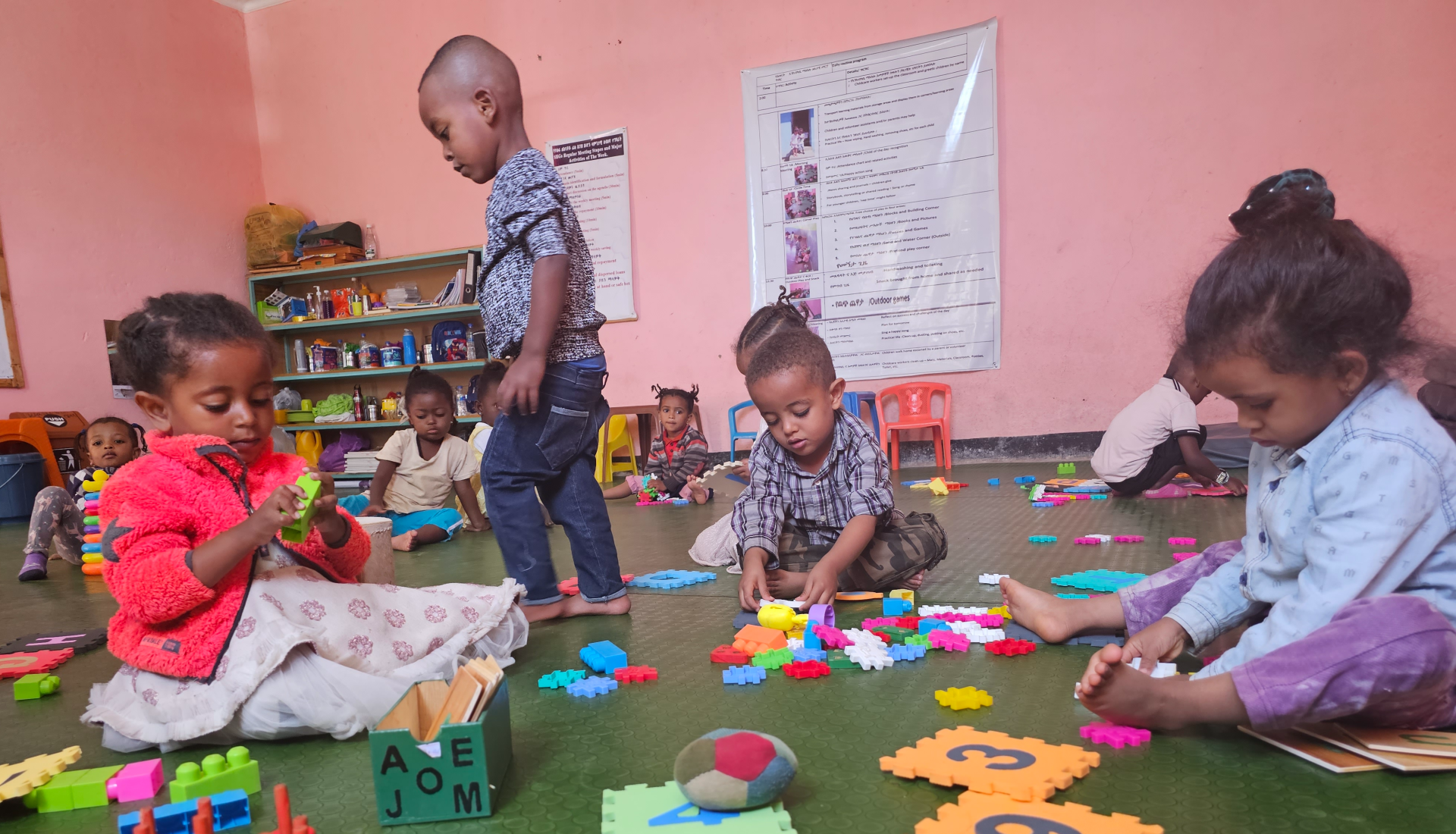
“All these years, I carried Hailu on my back while going to work. I was overjoyed when they told me that I could now take him to a daycare center while I worked. I had never heard of anything like that before!” exclaimed Seble.
For Seble, life took a turn for the better when she was enrolled in the GrOW project. “I was very happy to be enrolled in this project. They said it was for mothers with very low income and that their goal was to help us improve our economic status by enabling us to work so that we can provide for our families.”
Today, thanks to the support of the GrOW project, Seble can work without worrying about Hailu’s care, and she is on the path to financial independence. “Now, I can focus on my work and make a better income. My son is happy, safe, and learning at the center,” she said with a smile.
The mothers are also organized into Self-Help Groups of 20 members from each childcare center. They hold weekly meetings to discuss their social and personal issues, attend educational talks on child growth and development, contribute weekly savings, and take or repay loans from this kitty to engage in small businesses. Within a period of 2 years (2022 – 2024), the 16 self-help groups with 320 members, resulting in $11,450 in savings and $37,798 loans for small businesses, whose incomes rose by over




Related Resources
Testing innovations to shift and reduce unpaid care work in East Africa
In 2023, some 708 million unemployed women worldwide cited care responsibilities as keeping them out...

ChildFund Honored by Ministry of Women and Social Affairs for Excellence in Child Protection and Alternative Childcare
ChildFund has been recognized by the Ministry of Women and Social Affairs for its outstanding...
Haymanot is sewing her way to prosperity – one stitch at a time
The supported youth are now running small businesses in diverse vocational fields including welding, masonry,...